
At Mexiwin Casino we see it every single day: a player hits two jackpot symbols, the third reel slows down, teases them for a full second… and then stops one position away. The screen flashes “Close!” in bright letters. The player leans forward, heart racing, and spins again. And again. That feeling — that gut-wrenching, strangely hopeful “so close” moment — is not an accident. It is one of the most powerful psychological tools ever built into gambling, and it has a name: the near-miss effect.
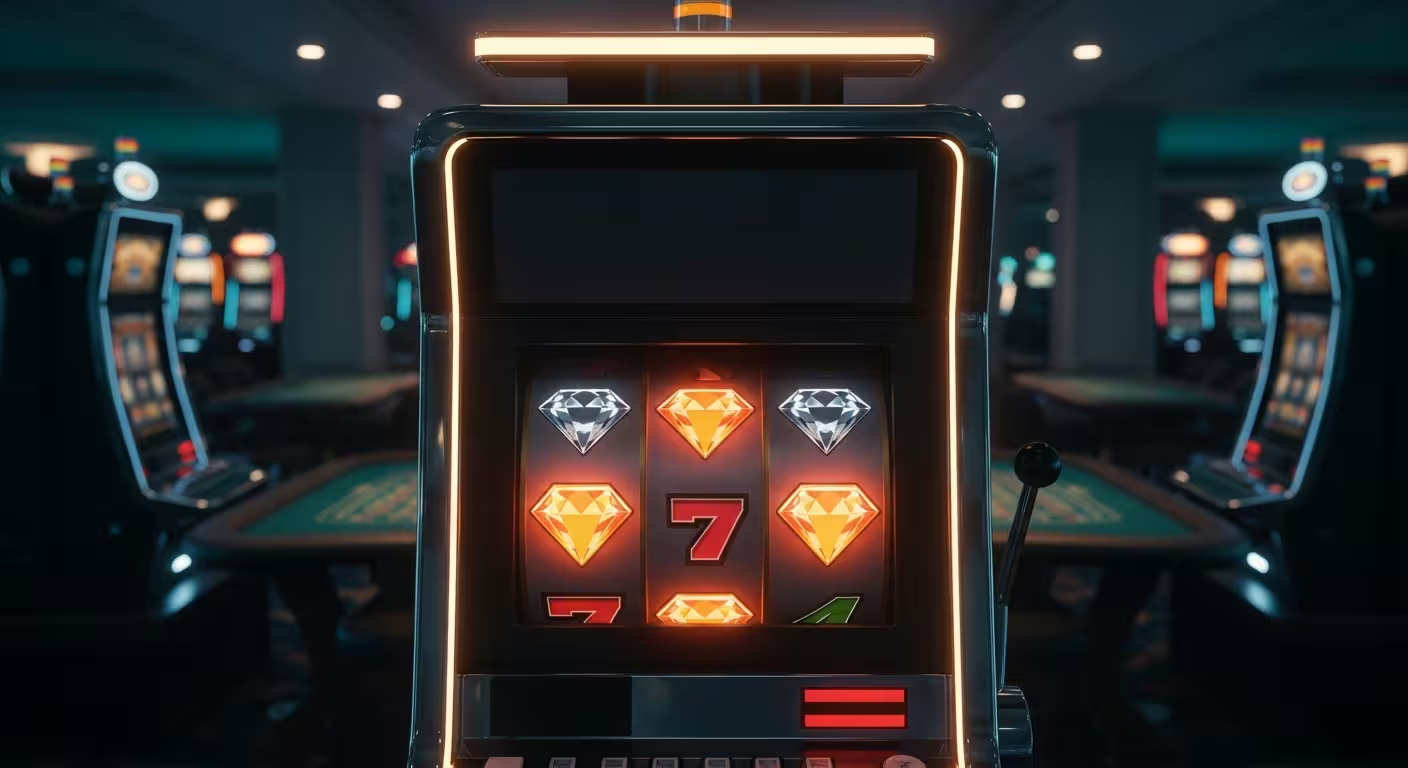
Here is the truth that most players never hear: your brain does not distinguish clearly between “I almost won” and “I won.” In the moment the third symbol stops just short, your brain releases almost as much dopamine as it would on an actual jackpot. That chemical rush is so strong that it overrides logic. You don’t feel like you lost. You feel like you were robbed of a win that was rightfully yours. And that feeling is incredibly hard to walk away from.
After years of studying player behavior and working directly with neuroscientists, I can tell you that near-misses are not random. They are carefully engineered. Slot developers know exactly how to program the reels so that winning symbols appear just above or below the payline far more often than pure chance would allow. The result is a constant stream of “almost” moments that keep your nervous system in a state of high alert and emotional investment.
Think about it for a second. When you actually win, the story ends. You feel good, you might cash out, you might take a break. But when you almost win, the story feels unfinished. Your brain hates unfinished stories. It wants resolution. So it pushes you to spin again… and again… until the near-miss finally turns into a real win (or, more often, until your session ends in frustration).
| Outcome | Brain Response | Emotional Feeling | Typical Player Action |
|---|---|---|---|
| Clear Loss | Low dopamine | Disappointment | Often stops or reduces bet |
| Near-Miss | High dopamine surge | Frustrated hope | Immediately spins again |
| Actual Win | Strong dopamine + reward | Joy + satisfaction | May cash out or celebrate |
| Big Near-Miss (Jackpot tease) | Very high dopamine | Heart-racing regret | Chases the feeling for much longer |
This is why near-misses are considered more dangerous than regular losses. A clear loss gives your brain closure. A near-miss gives your brain a mission. At Mexiwin we have seen players chase near-misses for hours, convinced that “the machine is due” or that they are “getting close.” The truth is much simpler and more human: they are chasing the feeling of almost winning, not the money itself.
If you want to understand how randomness actually works underneath these emotional moments, read our earlier deep dive: Quantum Physics and Random Number Generators: A Casino Deep Dive. The same pattern-seeking instinct becomes even more visible in immersive environments like futuristic VR casinos, where sound, motion, and presence can make every close call feel larger.
“The near-miss is the slot machine’s most elegant lie. It tells you that you were close, when in reality you were exactly where the game wanted you to be — ready to play again.”
Question: Are near-misses illegal? Answer: No. They are a legal and widely used design feature, but they must still meet strict regulatory standards for randomness in licensed casinos. Question: Why do some slots have more near-misses than others? Answer: Because developers deliberately tune the frequency to match the game’s volatility and target audience. High-volatility games often use more dramatic near-misses. Question: How do I stop falling for them? Answer: The most effective way is to decide your session length and loss limit before you start playing, and to treat every near-miss as a normal loss — because that is exactly what it is.
For deeper scientific background on this phenomenon, I recommend the research compiled by the National Institutes of Health on near-miss effects in gambling.
The near-miss effect is not going away. If anything, modern slots are becoming even better at creating these emotional hooks. The real question is not whether the game is trying to influence you — it is whether you understand how it is doing so. The emotional control taught in the art of bluffing helps here too, and the more social pace of live dealer games can make those automatic chase reactions easier to notice. Once you see the mechanism clearly, the spell loses some of its power.
At Mexiwin Casino we believe in giving players both the thrill and the truth. Play with awareness. Set your limits. And remember: the most important win is the one where you still feel good about yourself when you walk away.